
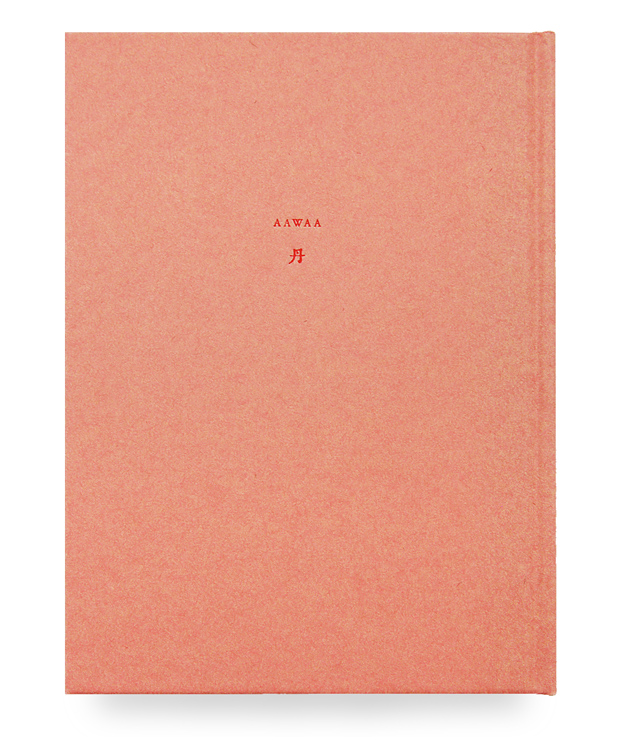
AAWAA『丹』
発行:赤々舎
Book Design:吉村麻紀
発行:Taka Ishii Gallery, 赤々舎
Size:H210mm x W158mm
Page:72 pages
Binding:Hardcover
Published in September 2025
ISBN:978-4-86541-208-6
¥ 5,000+tax
国内送料無料!
About Book
自然と人はどのように関わり、何を「美」として受け継いできたのだろうか。
そして、私たちは日々の暮らしのなかで、その営みとどのようにつながりうるのだろうか─
美術、建築、工芸、服飾といった複数の領域をゆるやかに横断しながら、無名性の高い表現を続けてきたAAWAAは、作家名の呼び方さえも鑑賞者に委ねてきた。その姿勢は、歴史のなかで名を残さずとも確かに存在した無数の創造行為や、名もなき人々が紡いできた「美」や「心」に想像を向けることと深く通じている。
作家自身が生活と創造の拠点として選んだ京都・南丹市美山。そこで培われてきた時間や経験は、2023年、「丹(に)」と題された作品へと結実し、丹後古代の里資料館において、弥生時代後期の遺物と呼応する空間インスタレーションとして発表された。
展示の契機となったのは、同資料館で出会った墳墓から出土した「丹」の土である。赤く染まるその土は、かつて海を越えて人と人を結び、儀礼や生活のなかで重要な意味を担ってきた素材だった。この出会いを起点に、「丹」は、海と時代を越えて連なってきた創造の歴史をたどるプロジェクトへと展開していく。
かつて異郷の地にたどり着いた人々が見出した「美」とは何だったのか。そして、現代を生きる私たちが、海の向こうにある未知の世界に見出そうとする「美」は、それとどこかで響きあっているのだろうか。
本書『丹(に)』は、そうした問いを静かに抱えながら、遥かな時間から受け継がれてきた自然と人との営み、そして日々の暮らしのなかにある小さな創造の連なりを想起させる一冊である。
生きる土地の傍らにある素材を用い、暮らしの空間を手探りでつくっていくこと。絵を描くように、器を形づくるように、木を組み、紙を貼り、壁を塗ること。
それらのひとつひとつは、AAWAAが日々の生活のなかで実践してきた行為であり、同時に、美術家として目指す「美しい術」と「思考」が交差する地点でもある。
Ni
AAWAA
In ancient times, the large province of Tango occupied most of the Tango Peninsula. I live nearby, in Miyama, which is in the Nantan area in central Kyoto Prefecture, once a part of Tango Prov- ince. Nantan and Tango both employ the character Tan /Ni (丹), as do many other place names in this region. […]
I’ve often come across landscapes marked with red; red soil left exposed on eroded mountain slopes, bright red well-water, red-tinged water seeping from the ground, stones in mountain streams stained with red deposits. The land here is rich in iron and it is said that the many place names containing the character Tan / Ni, which refers to “red” or to a “reddish mineral,” are de- rived from this red soil. When fired, the soil becomes red iron oxide, which is used as a pigment. It is here that my contemplation of Tan / Ni began. […]
In Tango, red pigment was once produced by crushing cinnabar, a mineral composed primarily of mercury sulfide. Back in the prehistoric Jomon period, I wonder if cinnabar may have represented life itself ? The Jomon people are thought to have applied red powder to their faces and bodies, much as people did with white pigment in later eras. Perhaps by adorning themselves with cinnabar, they sought to maintain physical and spiritual well-being. In the Yayoi period (c. 300 BCE − 300 CE), as rulers emerged, cinnabar came to be used in rituals and funerary practices. […]
Traces of cinnabar unearthed from the Misaka Shrine Burial Mound Group in Tango are housed in a museum storeroom. The soil is still stained the vivid red of cinnabar, imbued with the living presence of ancient times. It was found near the head areas inside wooden coffins, indicating that it had been applied to the heads of the deceased. Tubular glass beads, used as head ornaments, were found adhered to the cinnabar. I am also struck by the many offerings of broken pottery and shards excavated from the burial mounds. These were part of an ancient funerary ritual known as the Offering of Fragmented Pottery, in which vessels were intentionally broken around the wooden coffin during burials. The reason for this practice remains unknown but the shards are unmistakably Yayoi pottery, made from the red soil of this region. Intriguingly, alongside the jars, urns, bowls, pedestaled bowls, and water pitchers, miniature versions of the same vessels were also unearthed.
At the museum, a series of photographs documenting the excavation of the burial mounds caught my eye. I found myself captivated by the beauty of the scenery surrounding the finds. Though the images were meant as archaeological records, seen in a different light, they appeared as red earth spaces, like architecture rendered in red, with each detail precisely arranged. I wanted to bring such spaces into being. I photographed the photographs and then gazed at them for days, reimagining these spaces.
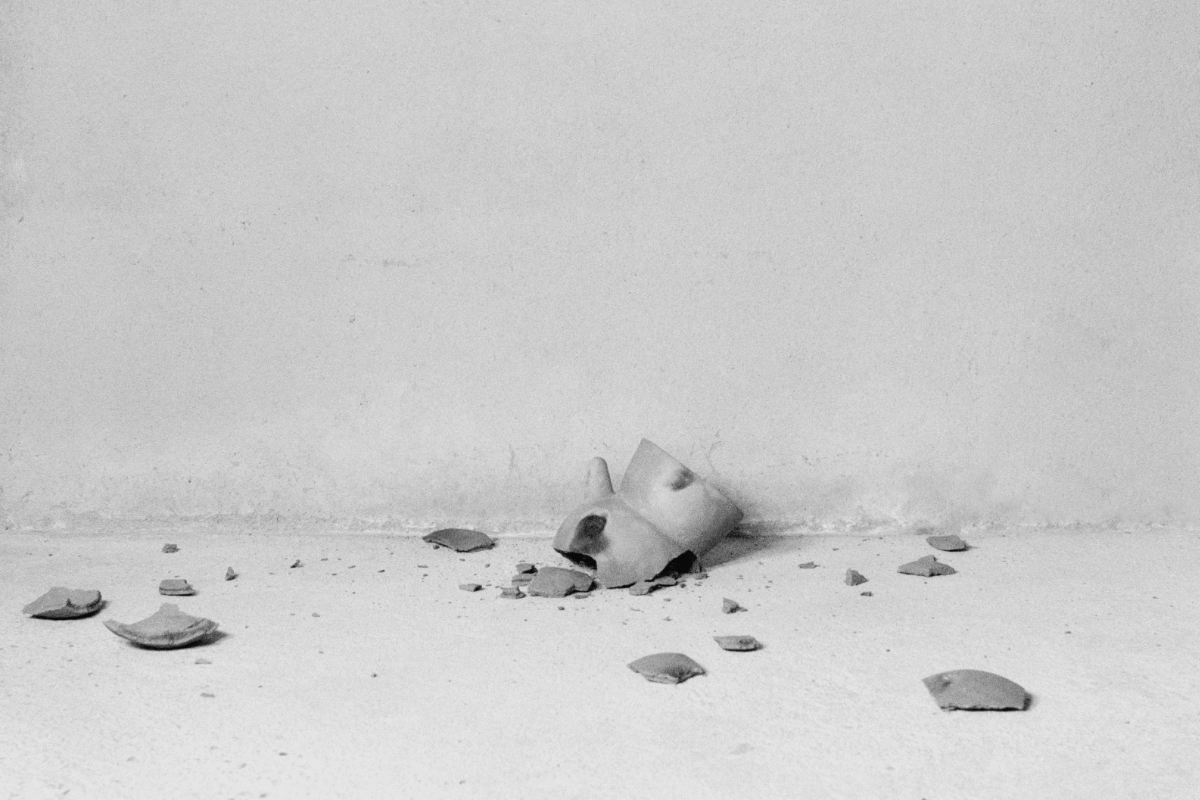
One day in Taiza, Tango, I came across a hill with strikingly red soil. With only a few steps my white shoes had turned red. That same day, I acquired a piece of beautiful silk fabric, woven in Tango using time-honored techniques. I recalled that silk threads had been found clinging to artifacts excavated from the Imai Burial Mound Group, and this was said to be the oldest known silk from Yayoi-period Tango. Silk production had already begun in this region during that time. I bundled the silk cloth and buried it in the red soil of the hill, dyeing it with the earth itself. The fabric bundles, placed into holes I had dug, reminded me of the wooden coffins from the Misaka Shrine Burial Mound Group. I left the fabric underground for a while and brought some of the red earth back with me to make pottery. With detailed drawings of the shattered offerings excavated from the Misaka Shrine Burial Mound Group as a guide, I reproduced nearly identical vessels (jars, bowls, pedestaled bowls, water pitchers, and miniatures of the same) and fired them in the open air to produce Yayoi-style pottery. When the pieces were complete, I raised each one high up and then smashed it into the ground. But who was I smashing it for?
After some time had passed, I dug up the buried bundles of fabric, as if carrying out an archaeological excavation. The silk had absorbed the color of the red earth, and mold had bloomed across its frayed surface, forming patterns of unexpectedly beautiful color. In Kamiseya, in the mountains of Tango, there is a tradition of weaving fabric with wisteria vines. The long tendrils are harvested and, after numerous steps, processed into thread. Kamiseya is also home to papermakers who produce beautiful handmade paper, and one of them mixed my red-dyed silk with paper mulberry harvested from the area and added cinnabar to create a paper pulp. This was then applied to enough wisteria thread to weave a full bolt of cloth. Red thread was spun day after day, and after several months, the wisteria weaver completed the red cloth. Wisteria thread is said to date back to the Jomon period, while silk arrived later on, during the Yayoi period. Wisteria and silk, joined by cinnabar and the paper mulberry plant; all are materials found in this region since ancient times. What emerged was Ni – Earth Fabric, which resembled the rare and precious “otsuzure” fabric.
I used lacquer to mend the vessels that I had broken, restoring them to a usable state. This marked the beginning of my series, Fragmentary Offering Vessels. The shards unearthed from burial mounds were broken as part of funerary rites for dead rulers, and were never to be repaired or used again. However, the vessels I broke were not offerings for them. Perhaps I broke them for myself. And since I have no plans to be buried anytime soon, I want these Fragmentary Offering Vessels to serve a purpose in daily life instead.
A red earth dwelling was built in Taiza. A large quantity of red soil from the hill was carried in, and the space I had envisioned took form. The building was enveloped in red earth, forming a place where the beauty of ancient times could be laid to rest. On a platform of compacted red soil, I placed the Ni – Earth Fabric.
This land, steeped in tan since time immemorial, was once a quietly radiant place where the planet itself glowed red. In an age when those who sought inner stillness let that light shine gently, it was swallowed by the immense might of those who came from across the sea. That delicate light was mined and transformed, giving rise to a vast new domain, which in turn became a nation. I was born into that domain, which lives on in a different form. But quietly, and alone, I slip away here. Taking only the beauty that remains in this land, I shape a new place where that red light can shine softly once more.
Related Event
AAWAA 個展「丹」
会期:2025年8月30日(土) 〜9月27日(土)
時間:11:00〜19:00
会場:タカ・イシイギャラリー 京橋( 東京都中央区京橋1-7-1 TODA BUILDING 3F)
日、月、祝 休み
AAWAA「丹」刊行記念トーク
日時:8月30日(土)16:00 – 17:00
会場:TODA BUILDING 4階 CONFERENCE ROOM 403
AAWAA(美術家)、徳田佳世(NPO法人 TOMORROW代表)、橋詰隼弥(「あしたの畑」プロジェクト・マネージャー)
予約制(定員: 30名)
Artist Information
AAWAA
日本生まれ。現在、京都北部の里山にある草葺家屋の古民家を拠点に活動。COSMIC WONDER主宰。立体、絵画、写真などのメディウムを介し、自身の経験した事象を主体に精神的な空間を構成している。主な個展として、「溌墨智異竜宮山水図」Taka Ishii Gallery (2018年)、「ECHOES」Taka Ishii Gallery (2011年)、「UNIVERSAL LOVE」Taka Ishii Gallery (2009年)。主なグループ展として、「あしたの畑 2024」京丹後・SEI TAIZA / TAIZA レジデンス(2024年)、「ECHO あしたの畑―丹後・城崎」京丹後市立丹後古代の里資料館(2023年)、写真とファッション 90年代以降の関係性を探る」東京都写真美術館(2020年)、ヨコハマトリエンナーレ2011 OUR MAGIC HOUR―世界はどこまで知ることができるか?」横浜美術館(2011年)、「MOTコレクション Plastic Memories―今を照らす方法」東京都現代美術館(2010年)など。
AAWAA
Born in Japan. AAWAA is currently based in a traditional thatched house in the countryside north of Kyoto. Founder of COSMIC WONDER. Whether through three-dimensional media, painting, or photography, he expresses a spiritual space whose subjects are his personal experiences.
His solo exhibitions include “Splashed Ink Chii Ryugu Sansui-zu”(Taka Ishii Gallery, 2018), and “Echoes”(Taka Ishii Gallery,2011). Group exhibitions include “Tomorrow Field 2024″(Tango, Kyotango, 2024),”Echo:Tomorrow Field-Tango, Kinosaki”(Tango, Kyotango, 2023),”Photography and Fashion Since the 1990s”(Tokyo Photographic Art Museum, 2020),”Yokohama Triennale 2011: Our Magic Hour -How Much of the World Can We Know?”(Yokohama Museum of Art, 2011),”Space for Your Future”(Museum of Contemporary Art Tokyo, 2007),and “MOT Collection: Plastic Memories – to illuminate now”(Museum of Contemporary Art Tokyo, 2010) .


